Blogs
Welding Positioners vs. Pipe Rotators: Which One Do You Need?
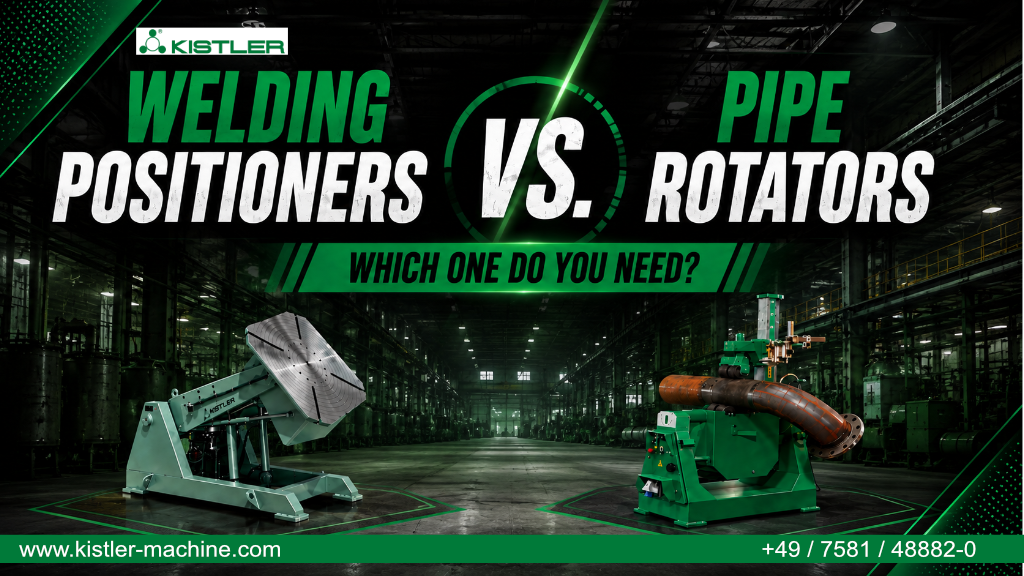
The only similarity between welding rotators and pipe rotators is that both of them function by moving a part into a good welding position. Which is why they both often get mixed up when function- wise, they’re miles apart. Picking the wrong one for any of their tasks can mean fighting an awkward part all day or paying for a machine you don't need.
Welding Positioner
The
wedding positioner can both rotate and tilt a workpiece while holding and moving it. It almost always favours placing the workpiece flat and face-up, because that position particularly makes the welding process faster, easier and cleaner.
Its greatest advantage would be its ability to weld oddly shaped workpieces, including pipe fittings, valve bodies, or parts with bits sticking out at angles. This is the reason why these positioners are common in workshops and handle all types of parts. This versatile welding equipment is available in different ranges as well.
What a Pipe Rotator Does
The
pipe rotator does one task over and over: spinning a round part around its own centre. The object can be anything from a pipe, tank or drum. Unlike the rotator, it cannot tilt or reposition the workpiece—it can only turn.
This sole objective makes it really helpful for welding tasks that go all the way around a pipe or tank. You hold the welding torch still, and the rotator brings the seam to it at a steady speed. They are commonly found in factories, continuously delivering tanks, boilers and long pipe sections.
Easy Way to Remember
A positioner moves and tilts parts into position, especially oddly shaped ones. The rotator just spins round parts continuously.
| Operation | Welding Positioner | Pipe Rotator |
| Movement | Tilts & Rotates | Only rotates |
| Best for | Oddly shaped parts | Round parts like pipes & tanks |
| Typical weld | Angled joints, made flat | Circular (all-the-way-round) welds |
| Best environment | Repair shops, varied jobs | Factories making the same shape repeatedly |
| Weight Range | Roughly 100 kg to 10+ tonnes | Depends on pipe or tank size |
| Example use | Pipe fittings, valve bodies | Tanks, boilers, pipe sections |
Don't Just Look at the Weight Limit
The weight capacity is not the most important thing about the positioner. Where all that weight sits on the part is also important. As the part goes far from the centre, it starts to put more strain on the positioner, regardless of how heavy the workpiece is. So, before making the purchase, give him a detailed drawing highlighting all your requirements, and work it out rather than buying based on the weight alone.
Can You Use Both Together?
Yes, mostly when the job is on large tanks. The rotator spins the tank for the round welds while a separate arm moves the torch along the length for the straight welds.
Frequently Asked Questions
Can I use a rotator without anything else?
Yes, when the torch is still or handheld. Then, the pipe can be turned into position by a rotator alone.
What if I use the wrong machine?
It not only results in messier welds but also leads to straining its motors and results in an eventual tip-over by an overloaded, unbalanced positioner.
Do I need both?
You need a rotator when everything is round. But as soon as odd-shaped parts show up, you’ll require a positioner as well.
Bottom Line
The most important factor is that they are not two versions of the same machine. While the positioner handles workpieces that come in all shapes, the rotator offers continuous spin action for round-shaped objects. The choice becomes clear when you let the supplier know what your actual requirements are.