

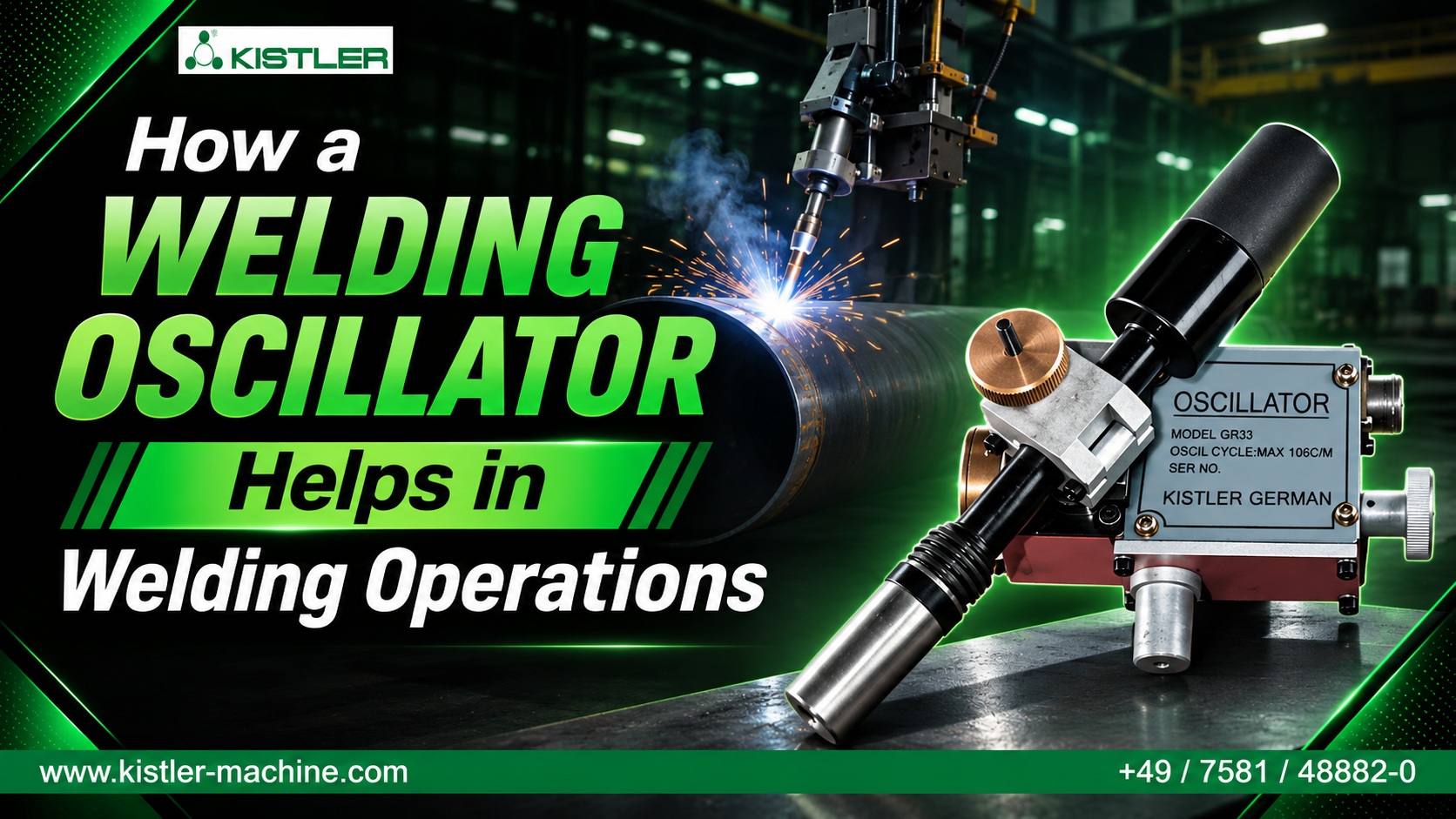
Welding generally requires steady movement throughout the job to keep the consistency of the results. Also, the weld quality is likely to vary when working with long seams or repeated joints. It is also a common requirement from a manual welder to control the torch movement throughout the whole process.
These tasks are better done with a welding oscillator in the industrial welding settings. It adds consistency by moving the welding torch or electrode from side to side in a controlled pattern. What this achieves is a better welding scope. When the weld is spread across a wider area, it also becomes helpful for the welder to maintain the required weld shape.
In short, the welding oscillator improves productivity, reduces manual effort, and supports better weld quality.
The welding oscillator is a device that controls the welding torch’s movement in order to improve its efficiency and maintain a consistent quality. It handles the side to side motion of the torch in a set pattern during welding operations.
If required, the operator can make adjustments to the movement speed and width according to the task at hand. When the settings change, the width and shape of the weld bead also change. The right setup makes the heat distribution even and produces consistent results.
With an oscillator, the operator is no longer required to control the torch movement manually throughout the weld. The side-to-side is automated, making the tasks more efficient and faster.
Manually keeping the torch steady is a tiresome task. With the help of an oscillator, repeated movement is handled better, allowing the operator to focus on the overall welding process. This alleviates the operator’s manual effort while still being able to monitor the weld and make sure the equipment works correctly.
A common risk factor associated with welding is that the process creates heat around the joint. When improperly managed, it can create deviation in the weld shape and affect the surrounding material.
With the controlled side-to-side movement, spreading the weld over the required area is easier.
Any variation in the torch movement affects the quality of the width and the appearance of a weld bead. But a welding oscillator follows a set movement pattern and keps variations to a minimum.
The result is more uniform welds and reduced spatter rate.
- Pipes and Tubes
- Tanks and Pressure Vessels
- Flanges and Fittings
- Structural Fabrication
- Industrial Manufacturing
Selecting a welding oscillator should be based on the type of joints you weld, material thickness, and the required weld width and the welding position. Make sure the oscillator you are looking at is compatible with your operations and features the movement you require. Kistler offers welding oscillators in its GR-32 and GR-33 ranges for applications involving pipes, tubes, tanks, flanges, and fittings.
A welding oscillator automates the side-to-side movement of a welding torch/electrode. It reduces manual repetitiveness and offers top welding quality with its consistent and comprehensive welding movement.
Explore Kistler’s welding oscillator range here and learn more about the available equipment.